
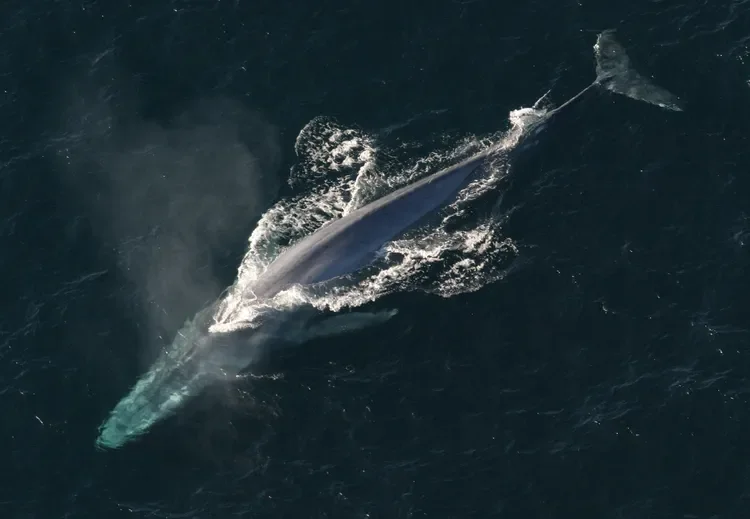
Photo Credit: NOAA Photo Library/Wikimedia Commons Via ThoughtCo.
After more than 60 years since the commercial whaling of blue whales was banned globally, new evidence shows that there has been an increase in sightings of blue whales. This increase has been especially prevalent over the last few years.
As of data published on Aug. 15, the blue whale (Balaenoptera musculus) is classified as endangered globally, while the Antarctic blue whale subspecies (Balaenoptera musculus intermedia) remains critically endangered on the International Union for Conservation of Nature’s Red List. The current Antarctic blue whale population is 3 per cent of what it was before commercial whaling began, and since the commercial whaling ban, the population has been increasing by 5 to 8 per cent every year.
Scientists have found evidence that blue whales are returning, especially to areas where they were heavily hunted before. According to the British Antarctic Survey, in 2020, 55 blue whales were spotted over 23 days around South Georgia, a sub-Antarctic island belonging to the UK. Forty to 50 years prior, only two blue whales had been spotted around South Georgia.
Although the increased sightings suggest blue whales may be returning, greater observation effort and reporting could also help explain the increase.
Blue whales are present in all oceans except the Arctic Ocean. They migrate depending on the season between summer feeding grounds and winter breeding grounds. New evidence suggests that, in some areas, they don't migrate at all. Most whales move to where their food is most abundant.
For over 5,000 years, human civilizations around the world have been hunting whales. This started along Brazil’s southern coast. Up until the 1860s, blue whales couldn’t be hunted, due to their size, which made capturing and transporting them difficult.
It wasn't until 1863 when Svend Foyn invented a steam powered whale catcher that was strong enough to capture blue whales weighing up to 200 tons (equivalent to 400,000 lbs). This invention gained popularity first in Norway, between 1873 and 1883, and once blue whale stocks became depleted in the area, whaling expanded to Iceland and beyond. These boats made hunting blue whales easier, allowing whalers to catch them in greater numbers. Features like mechanical weapons including harpoons were added in the early 1900s, making hunting even more efficient.
By the early 1900s, 340,000 blue whales were killed. The International Whaling Commission (IWC) banned hunting blue whales globally in 1966 and the species was declared endangered in 1970. By the time the ban was put in place, 99 per cent of the blue whale population had been killed. Before whaling, the blue whale population was approximately 300,000. During peak whaling, numbers went down to about 1,000 to 1,500, and currently, there are approximately 10,000 to 25,000 blue whales.
The reported increase in the blue whale population may not only be due to the time elapsed since the whaling ban was implemented.
Conservation groups map blue whale migration routes to identify areas that need protection. This has resulted in slower ship speeds and shipping routes that avoid blue whale feeding areas, which reduces the possibility of collisions and fatal vessel strikes. In addition, it reduces underwater noise pollution from ships and industrial activities that disrupt blue whale echolocation.
Changes to fishing gear have also lowered the risk of blue whales becoming entangled in ropes and nets. Efforts made to protect the krill that blue whales rely on as a main food source has also been key to helping the species survive and reproduce.