
COP30 in Brazil Sees Protests and Stirs Controversy
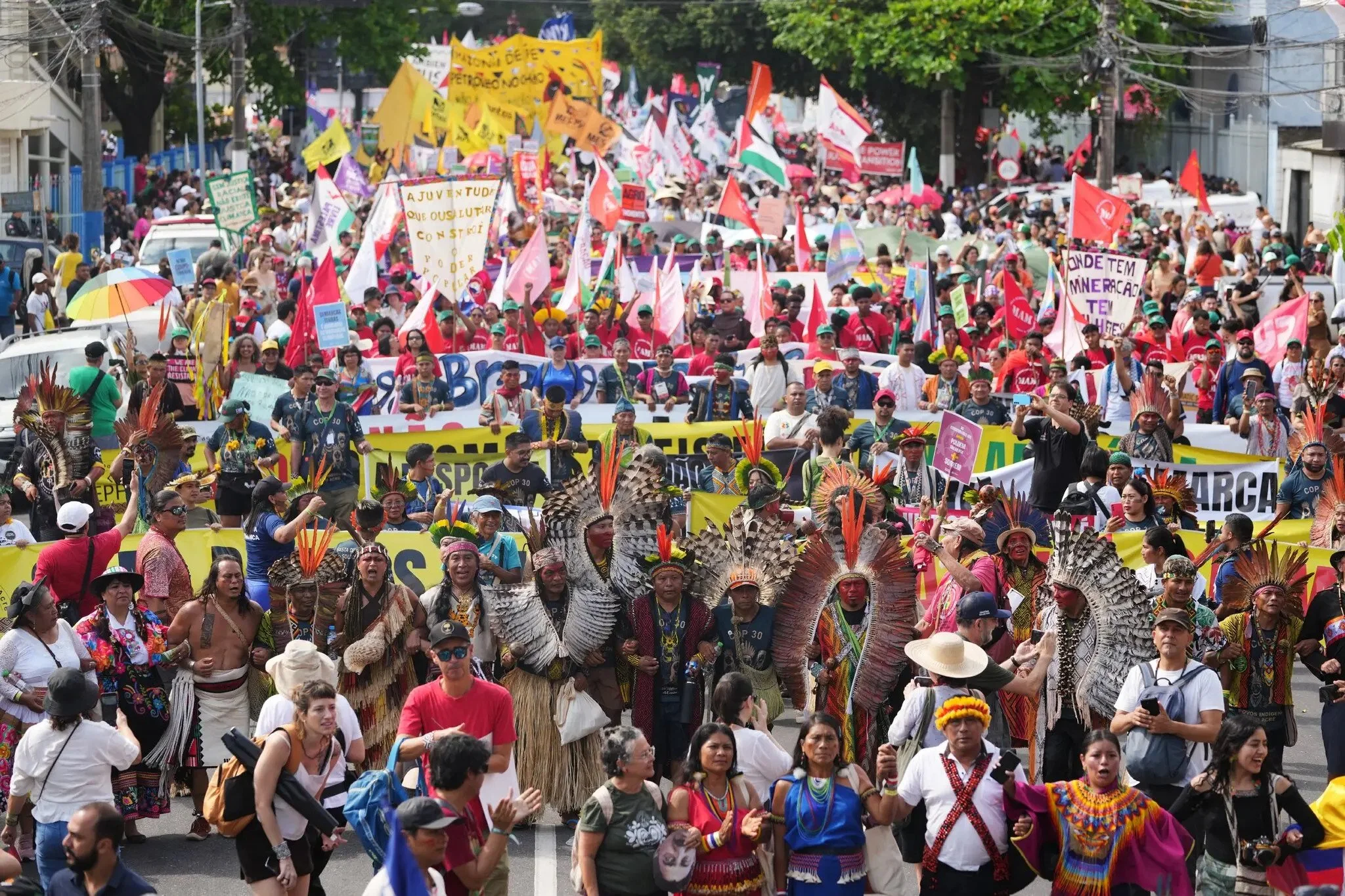
Photo Credit: Andre Penner/AP via The New York Times
The 30th annual Conference of the Parties (COP) summit was held in Belém, Brazil, from Nov. 10 to 21. COP30 saw nearly 200 countries discuss climate finance, climate adaptation, and national climate plans. Notably, the US delegation withdrew from negotiations and the event was marked by protests from Indigenous people.
COP summits were initially established as the supreme decision-making body of the United Nations Framework Convention on Climate Change (UNFCCC), an international agreement that provides the basis for global climate action. Currently, 198 countries have signed the UNFCCC, although five of them chose not to attend COP30 this year. Non-profit organizations and other key stakeholders also typically attend.
Groups at COP 30 included the non-profit World Wide Fund for Nature and the Indigenous Peoples Organization. On the other hand, several oil and gas companies, such as Petrobras and British Petroleum, typically attend in order to advance their own interests.
The primary goal of COP summits is to analyze and review the implementation of climate treaties such as the Paris Agreement and the Kyoto Protocol. The Paris Agreement is an international treaty adopted in order to limit global warming to well below 2 degrees Celsius, while the Kyoto Protocol was used to legally bind industrialized countries to reduce greenhouse gas emissions. These treaties were established at COP21 and COP3, respectively.
COP summits also serve as a place for governments to discuss climate targets, financing for climate action, and agreements on reducing emissions. Traditionally, each COP agrees to a binding agreement that is publicly shared at the end of the conference.
Thus far, many scientists agree that COP conferences are a vital platform to make improvements in the climate change situation.
COP30 has been dubbed the “Indigenous COP.” Due to the proximity of many Indigenous nations and the Amazon rainforest, the summit had a record participation of 3,000 Indigenous representatives.
Despite the large number in attendance, Indigenous representatives were largely excluded from official negotiating rooms. Only 14 per cent of Indigenous delegates had credentials to access the “Blue Zone,” a place where formal discussions were held.
Throughout the summit, Indigenous people protested, breaking through entrances and barriers to try to have their voices better heard. During these protests, a new grassroots Indigenous initiative called “Woven Project” emerged. The Woven Project is a new global Indigenous advisory platform on climate change that shares Indigenous knowledge and solutions to the crisis.
Many were surprised by the US’s absence from the COP-30 conference, as it was the first time in 30 years that the US did not attend the event. However, the US’s absence was in line with Donald Trump’s anti-climate stance.
Trump previously told PBS that climate change is “the greatest con job ever perpetuated on the world.” He added that climate financing has cost many countries “fortunes” and that the climate predictions were often wrong.
The US’s absence enabled China and Brazil to take a more central role in climate negotiations. Since the US has a big impact on climate finance, many are concerned that its absence could widen the gap between wealthy and developing countries.
Despite protests and nonattendance from the US, COP30 managed to strike a “Belém Political Package” to conclude the summit. This package is a set of agreements that advance climate finance and adaptation goals, but faced significant criticism for its weak language on fossil fuels.
Countries agreed to “at least triple” the funding provided to developing nations for climate adaptation by 2035. Another significant deal was the agreement to establish a mechanism to make sure that the global shift to a green economy is fair and protects the rights of workers, women, and Indigenous peoples.
Despite these deals, the package did not include a clear roadmap or commitment to phase out fossil fuels, a main cause of climate change. It only vaguely refers to accelerating the implementation of prior agreements. Many are coming to the consensus that the COP30 summit failed to implement strong new goals and are disappointed with the outcome.
“We have miserably failed to accomplish the objective of this convention, which is the stabilization of greenhouse gas in the atmosphere,” stated Panama’s climate envoy, Juan Gomez, in a LinkedIn post.
Furthermore, in a news report written by Myrto Tilianaki, the Human Rights Watch's Senior Advocate for the Environment and Human Rights, she stated that COP 30’s “failure to make any tangible progress on fossil fuels and deforestation means COP30 fell far short of what is needed to protect people and the planet.”