
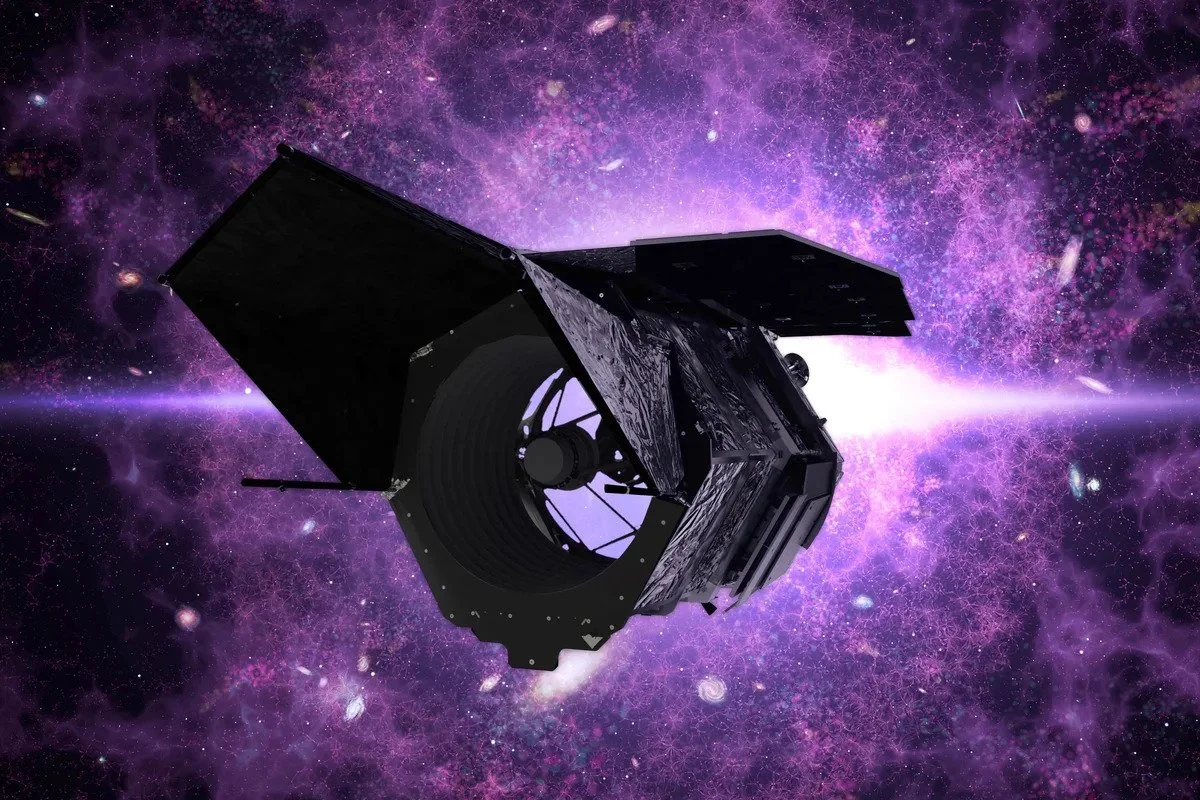
Photo credit: NASA Goddard Space Flight Center Scientific Visualization Studio via Scientific American
On Aug. 30, NASA launched the Nancy Grace Roman telescope. The infrared device will investigate dark matter, an invisible substance that has gravity but does not display light behavior; dark energy, a force that can accelerate the expansion of the universe; and extrasolar planets, which are planets that exist out of our solar system.
The telescope is named after Nancy Grace Roman, NASA’s first chief astronomer, also known as the “Mother of Hubble.” The Roman telescope is developed to work alongside Hubble. Over the mission’s five-year lifetime, the Wide Field Instrument will measure light from a billion galaxies. Its field view is at least 100 times larger than that of Hubble’s, allowing NASA to capture more of the sky in less time. On the other hand, the Hubble Space Telescope helps determine the age and expansion rate of the universe, and it helps capture information about distant star formations.
The Roman telescope will send approximately 1.4 terabytes of data to Earth per day, the highest data rate of any NASA astrophysics mission yet.
According to NASA, Roman will use its 2.4-meter mirror and Wide Field Instrument, a camera, to research how matter is configured throughout the cosmos and measure how the universe expands. These instruments can point out newborn black holes or exploding stars. In the process, Roman will help study galaxies across cosmic time, from the present back to when the universe was about half a billion years old.
The Roman Space Telescope's microlensing survey will monitor 100 million stars for hundreds of days, and it’s expected to find about 2,500 planets, including significant numbers of rocky planets within and beyond the region where liquid water may exist. This planet-detection method is sensitive enough to find planets smaller than Mars.
The Roman Space Telescope features a Coronagraph Instrument designed to block out a closer star’s light, allowing more obscure planets to be studied.