
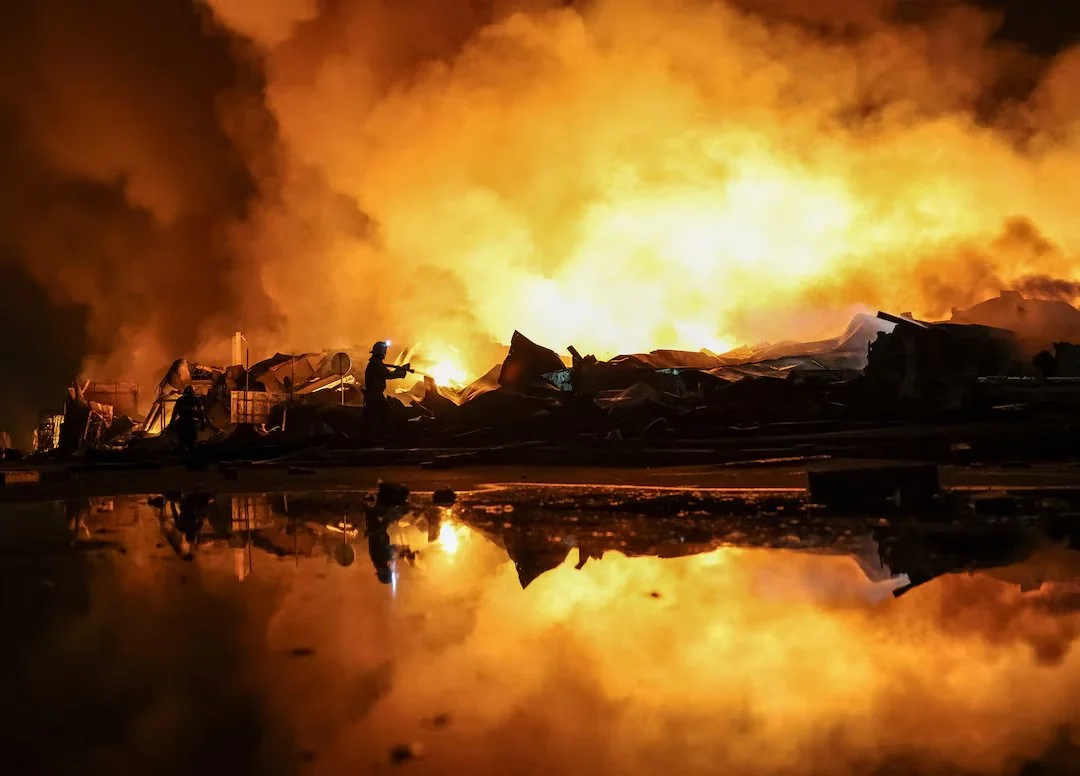
Anatolli Stepanov/Reuters
The warehouse is a hellscape. The air is thick with smoke, casting a haze through the room. Wrought iron shelves twist in unnatural directions, slowly giving out to collapse. Fire glows orange through the smog, eating its way through piles of books stacked high in every direction. Many are nothing more than crumbling ash, mutilated by flame. You can still make out the children’s picture books. Vivid blues, yellows, and reds pop through blackened, soot-stained pages.
On Aug. 1, Russia bombed the headquarters of Ranok Publishing in Karkhiv, destroying around eight million books. The attack came just prior to the upcoming school year, while there were over half a million textbooks sitting in the warehouse waiting to be distributed to students.
The bombing of Ranok is the latest in a series of escalating attacks on Ukraine’s cultural and scientific institutions, and part of an ongoing campaign to undermine Ukrainian intellectual culture. In the same month, a missile hit one of Kyiv’s oldest book markets, drones set fire to the National Academy of Sciences in September, and thousands more non-military infrastructures were demolished.
Literature has been a particular target in this evolving war. Since the beginning of the summer, it is estimated that Russia has wiped out around a third of Ukraine’s annual print production. Literature bears some of the strongest weight in cultural identity, now more than ever. It gives power to history, language, sensibility, and thought.
This is not just an invasion, but rather a fullscale attack on a language, a culture, a history.
It is under Putin’s conviction that “Russians and Ukrainians [are] one people – a single whole.” Although he has taken it to an extreme, Putin is not unique in this idea.
Russia has had a long imperial phase dating back to the 1700s, where it controlled a vast territory that included parts of Poland, all of Ukraine, and much of Eastern Europe and Central Asia. The actual origins of Russification — a form of assimilation of non-Russian groups into Russian culture, language, and identity — most likely date back to Soviet Russia.
Due to this condition, over the past few centuries, Ukraine has been off and on a part of Russia, and is viewed by some as an extension or little brother of Russia.
It’s not only extremist leaders who believe this, but a much broader audience. It is portrayed heavily through Russian media. Many great writers and thinkers fall under this strain of pan-Russian nationalism, from Alexander Pushkin – widely revered as the father of modern Russian literature – to Fyodor Dostoyevsky. A more modern example of this was Aleksandr Solzhenitsyn, who was a liberal anti-Soviet author in the USSR, but nevertheless, he was not sold on the idea of Ukrainian independence.
The “Executed Renaissance” refers to the generation of Ukrainian writers and artists that disappeared from history, alongside their work, during Stalin’s regime. In 1933, during the peak of Stalin’s suppression, his secret police targeted Slovo House, a creative hub that was home to many writers. They arrested the residents one by one, and executed 30 of them. The work of these writers only began to resurface after the collapse of the Soviet Union in 1991.
It is not unusual for authorities to use the erasure of culture as a tool of imperialism and domination. Quite a few other colonial powers follow a similar pattern. Algeria, under France’s 132-year rule, suffered heavy suppression of culture beginning with the assimilation of children into the French language and destruction of religious institutes.
The editorial staff at Ranok Publishing visited the warehouse a few days after the bombing to survey the damage. The attack wiped out at least 85 per cent of their total inventory. “When you see what was produced with your brain, with your hands, with your imagination, spoiled by Russia, it’s an awful feeling,” said Viktor Kruglov, the co-founder and CEO of Ranok, according to The Guardian.
Since the bombing, Russia has continued to scale up its attacks on civilian and military targets across much of the country. With Putin emboldened by the recent diesel fuel deal with the US, it looks like the conflict will only escalate over the winter.