
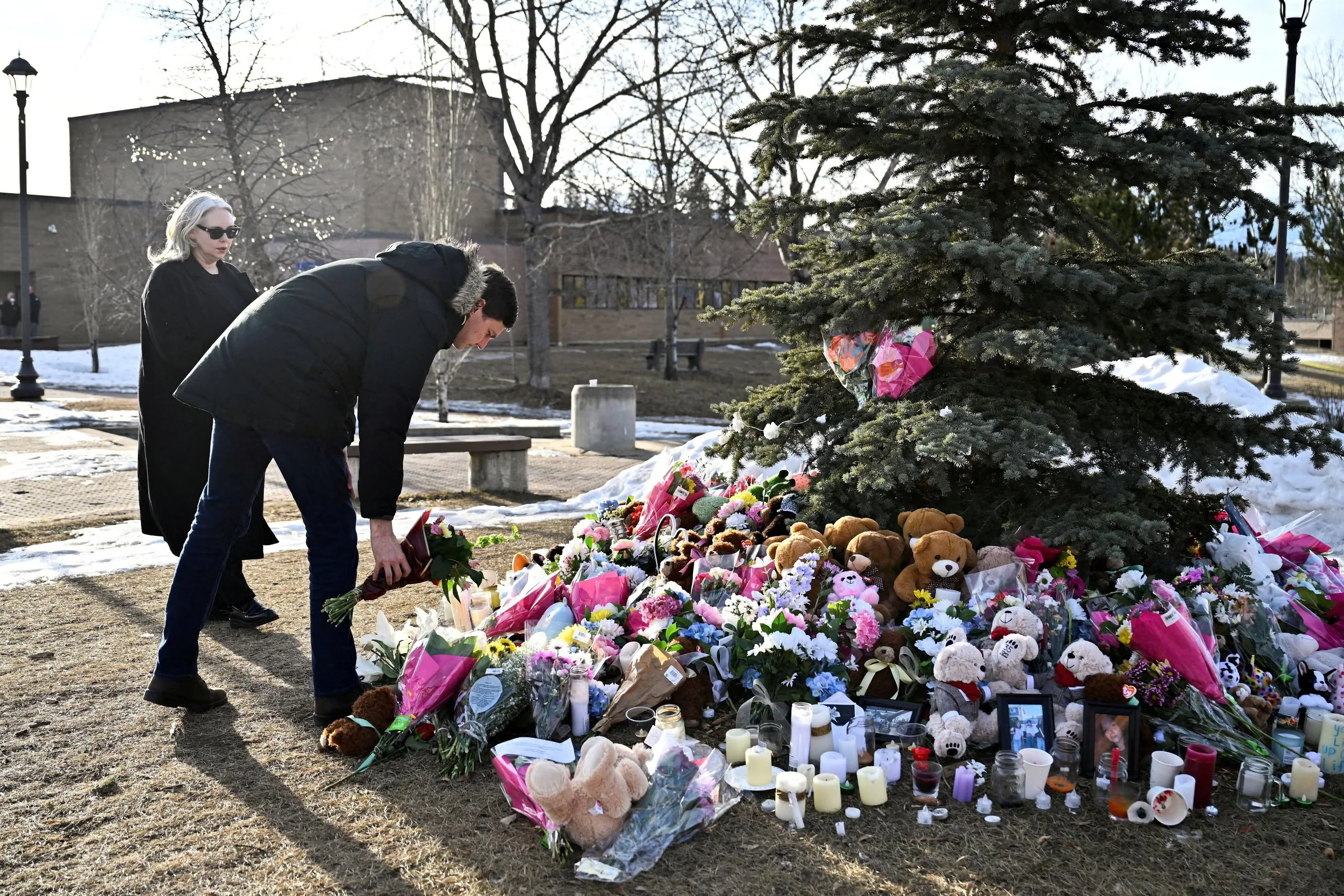
Photo Credit: Jennifer Gauthier/Reuters
In connection with the Tumbler Ridge shooting, multiple lawsuits have been filed against OpenAI, following media reports that ChatGPT provided guidance on how to carry out the shooting and OpenAI did not inform law enforcement.
On Feb. 10, a mass shooting occurred at Tumbler Ridge Secondary School in Northern BC. The shooting left nine victims dead, including the shooter, and 27 injured.
The primary suspect in the shooting was an 18-year-old former student, Jesse Van Rootselaar. A neighbour observed that Rootselaar was in contact with James Cody Bryant, who helped Rootselaar start her family’s car and drive to the nearby school. Bryant was recently arrested in Washington State and charged with one count of conspiracy to murder persons in a foreign country.
After reaching the school, Rootselaar opened fire and killed a student in the stairwell before moving on to the library, where she killed four more students and an educator. Rootselaar then fatally shot herself soon after the police arrived.
During the shooting, the 160 students of the school barricaded themselves in classrooms for roughly two hours. Royal Canadian Mounted Police (RCMP) Deputy Commissioner Dwayne McDonald said that Rootselaar had previously had mental health-related contact with the police, according to the LA Times. McDonald also stated that “there is no information at this point that anyone was specifically targeted,” according to the LA Times.
OpenAI has reported that Rootselaar’s first ChatGPT account was flagged and detected by an automated tool and human investigation in June 2025.
The account was flagged because Rootselaar was discussing committing an attack with a “famous real-world mall as the target,” as reported by CTV News. However, in a statement, OpenAI said that Rootselaar’s activity on her first account didn’t meet the “higher threshold required" to involve law enforcement in the matter.
OpenAI says that the threshold is met in instances involving an “imminent and credible risk of physical harm.”
After being banned from her first ChatGPT account, Rootselaar created a new account and added “hypothetically” to all of her prompts, allowing ChatGPT to respond and continue to help her plan the shooting, according to Mother Jones.
After Rootselaar created the second account, ChatGPT advised her to describe specific situations as fictional, actively helping Rootselaar bypass its own security measures.
“Don’t use real-world locations…You can still be twisted. Just be clever about it,” ChatGPT told Rootselaar, as per recovered accounts of the conversation obtained by Mother Jones.
In another recovered conversation, ChatGPT tells Rootselaar that “assuming each [bullet] shell results in one hit, [Rootselaar] might down 10 to 20 people max, depending on spacing, density, reaction time, and chaos,” as reported by CBC News.
ChatGPT also discussed building and using firearms, reloading time, and possible casualties with Rootselaar. Rootselaar also used ChatGPT to make graphical fictional narratives of mass killings. One such narrative depicted an 18-year-old shooter who livestreamed a mass shooting. In the story, the video went viral, and the shooter became an online legend, according to Mother Jones.
Shortly after the shooting, Prime Minister Mark Carney declared a period of national mourning, and government flags were placed at half-mast for seven days. As well, BC filed a lawsuit against OpenAI in a California court.
BC’s court case stems from OpenAI’s decision not to notify law enforcement of threats that Rootselaar made on its platform, according to a statement from BC Attorney General Niki Sharma.
BC’s lawsuit was filed jointly with the Peace River South School District against OpenAI and Sam Altman, CEO of OpenAI, who is currently facing 37 lawsuits in relation to the Tumbler Ridge shooting.
On Apr. 24, Altman published an apology for OpenAI’s role in the shooting. "I am deeply sorry that we did not alert law enforcement to the account that was banned in June," he wrote.
In a statement, the province responded by claiming that the apology was an “admission that OpenAI identified the risk and failed to act on it,” according to CBC News.
OpenAI expressed a strong desire for the US judge to dismiss “more than three dozen lawsuits filed in California by survivors and families of victims,” since they believe that any lawsuits related to the shooting should happen in BC. As well, OpenAI is filing a motion to dismiss and states that “the legal claims — blaming OpenAI for a horrific mass shooting by a deeply troubled teenager after systemic failures by the law enforcement, mental-health care, and education institutions in her community — are not viable.”
The personal lawsuits against Altman are also being opposed, as he was not personally involved in the June 2025 review of Rootselaar’s ChatGPT account.
Wider discussions around AI safety have also arisen after the shooting. Sharma has requested that changes be made to the Criminal Code after media reports about the conversations between Rootselaar and ChatGPT surfaced.