
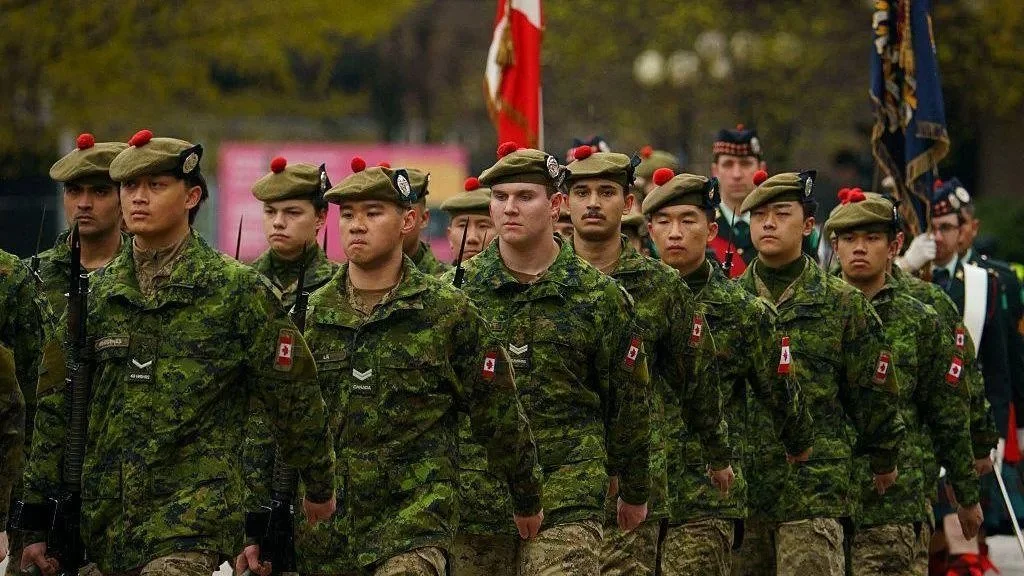
Photo Credit: Getty Images via Yahoo News
On Sept. 23, Prime Minister Mark Carney revealed in an interview to The New York Times that he had been looking over and discussing courses of action in the event of “US-led military action.” Carney said that his review of military plans is precautionary, stating that he has “a responsibility in these roles to look at the tail risk,” with said tail risk being the small chance of a US-led invasion of Canada.
When asked about the matter, Admiral Samuel Paparo of the US Navy said that he “find[s] that scenario absolutely and completely preposterous,” and compared a US invasion of Canada to an invasion of Mars, according to Global News.
When questioned about Carney’s comments, Minister of National Defence David McGuinty said in an interview to The Canadian Press that “All militaries in the world spend time analyzing risk scenarios.” He agreed with Carney’s assessment and description, stating that the situation should be interpreted “as described by the prime minister, a tail risk.”
Previously, archaic Canadian plans for US invasions were outlined in the 1921 Defence Scheme No. 1. At the time of its publication, the primary defence measures were for Canadian forces to invade the northern United States in a bid to buy time for English forces to arrive and support Canadian forces.
With Commonwealth ties being severed since the inception of this plan, as well as Defence Scheme No. 1 being decommissioned and all copies being ordered destroyed as of 1933, it is unknown what the current defence measures for Canada are in the event of the described “tail risk” of an invasion by the US.
The formal announcement of an operations review by Carney comes after several reforms to Canada's armed forces. On Oct. 13, CBC News reported that the annual budget for the Canadian Armed Forces is expected to reach $95.6 billion by 2030, a $20.6 billion increase from the current 2026 budget.