
ANALYSIS | Doomsday Clock Set 85 Seconds To Midnight, Closer Than Ever Before
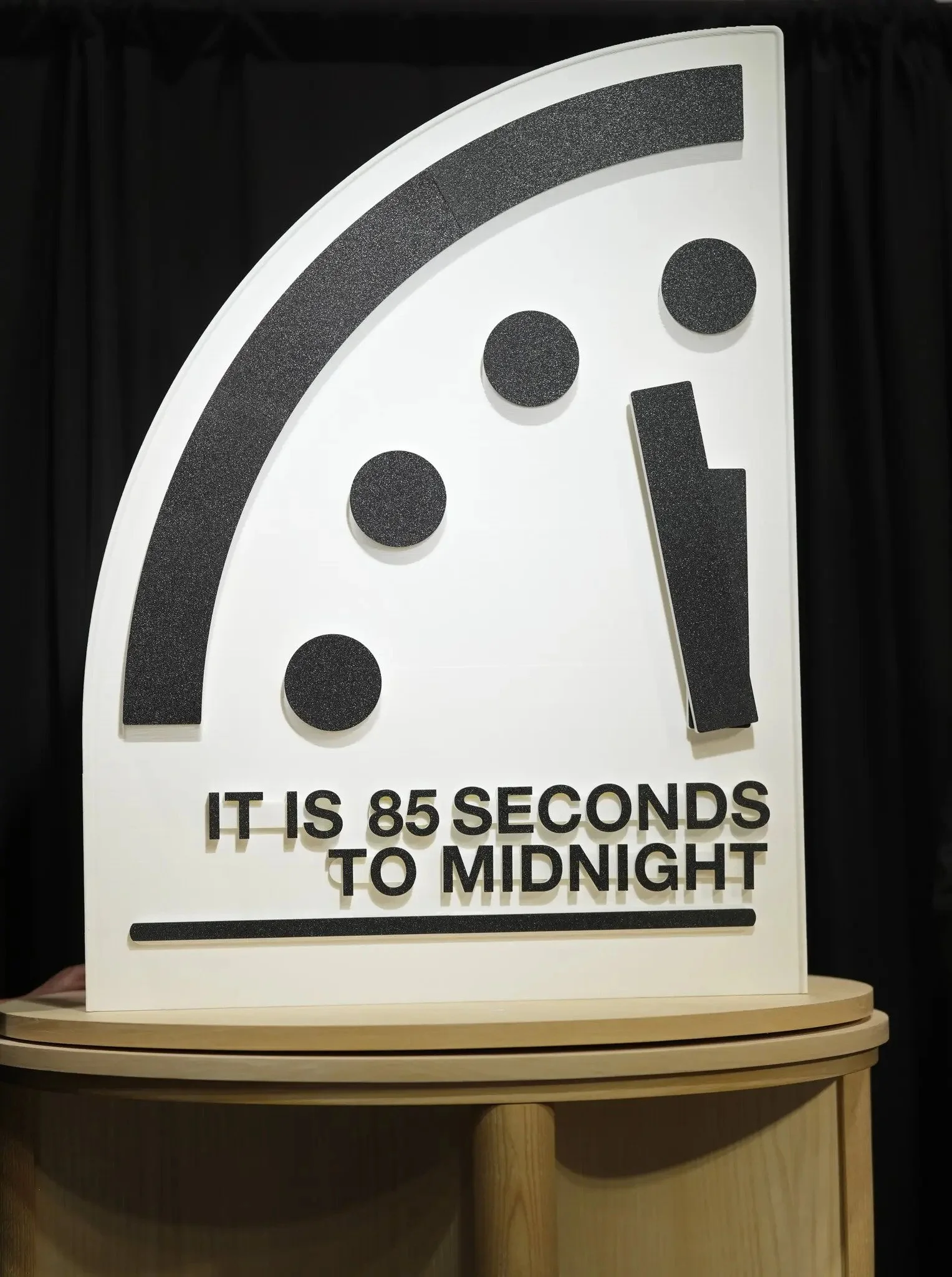
Photo Credit: Pablo Martinez Monsivais/Associated Press via The New York Times
Humans across the globe are warned from a young age about the importance of time and how little of it we possess. Every year, the world inches closer and closer to global disaster, and this year, the Doomsday Clock only further proves that daunting thought. This year, the Doomsday Clock is set to 85 seconds until midnight, which is the shortest amount of time that has ever been left, symbolizing that humanity is closer than ever to reaching the hypothetical “apocalypse.”
The Doomsday Clock is a universally recognized indicator of the “world’s vulnerability to global catastrophe caused by man-made technology,” according to its creators, the Bulletin of the Atomic Scientists. The Bulletin of the Atomic Scientists, or the Bulletin, is an independent, non-profit media organization founded in 1945 by the scientists who helped develop the world’s first atomic bomb during the Manhattan Project.
The Bulletin created the Doomsday Clock in 1947 to alert the public of how close they are to destroying the world in a nuclear war; the amount of time humanity has left before self-destructing is represented by the number of minutes or seconds there are until midnight, which is a symbol for the apocalypse. At the time of its creation, the clock was set to seven minutes before midnight.
The Doomsday Clock doesn’t follow a strict formula every year to determine how much time we have until midnight. Instead, it is determined by the expert assessments of the Bulletin’s Science and Security Board (SASB), which consists of “global leaders with a specific focus on nuclear risk, climate change, and disruptive technologies.”
This year, the SASB took into account the dangers of nuclear war, climate change, the misuse of biotechnology, and the potential threat of artificial intelligence when estimating humanity’s proximity to the apocalypse.
In a statement released on Jan. 27, SASB argued that there has been an increase in active nuclear threats and aggressive geopolitics, from the increasing numbers of nuclear warheads and platforms in China to the US’ plan to deploy a new, multi-layered defense system known as the Golden Dome that will include space-based interceptors. Furthermore, the nearly 60-year-old arms treaty between the world’s two largest nuclear countries, the United States and Russia, expired on Feb. 5. The treaty, called the New Strategic Arms Reduction Treaty (New START), previously limited the number of strategic nuclear warheads deployed by the US and Russia.
Furthermore, the SASB pointed to the world’s failure to take feasible steps toward international agreements to fight against climate change.
Additionally, the SASB warns of the dangers of new bio-technology, citing threats including state-sponsored biological weapons programs and the rapid degradation of US public health infrastructure and expertise, which reduces the ability of the US and other nations to respond to biological threats.
Finally, the SASB points to new risks that have materialized with the recent rise of artificial intelligence. “The AI revolution has the potential to accelerate the existing chaos and dysfunction in the world’s information ecosystem, supercharging mis- and disinformation campaigns and undermining the fact-based public discussions required to address urgent major threats like nuclear war, pandemics, and climate change,” SASB cautioned.
Overall, SASB concluded that “our current trajectory is unsustainable. National leaders — particularly those in the United States, Russia, and China — must take the lead in finding a path away from the brink. Citizens must insist they do so.”
However, whilst the Doomsday Clock is a strong symbolic figure, it does have its limitations.
“It’s an imperfect metaphor,” Dr. Michael Mann, Presidential Distinguished Professor in the department of Earth and Environmental Science at the University of Pennsylvania, told CNN in 2022. He believes that the clock oversimplifies complex global issues by combining them into a single time metaphor, as the various risks to humanity accounted for by the clock all have different characteristics and occur within different timescales. However, he added that the clock “remains an important rhetorical device that reminds us, year after year, of the tenuousness of our current existence on this planet.”