
Ebola Cases in Africa See Recent Spike
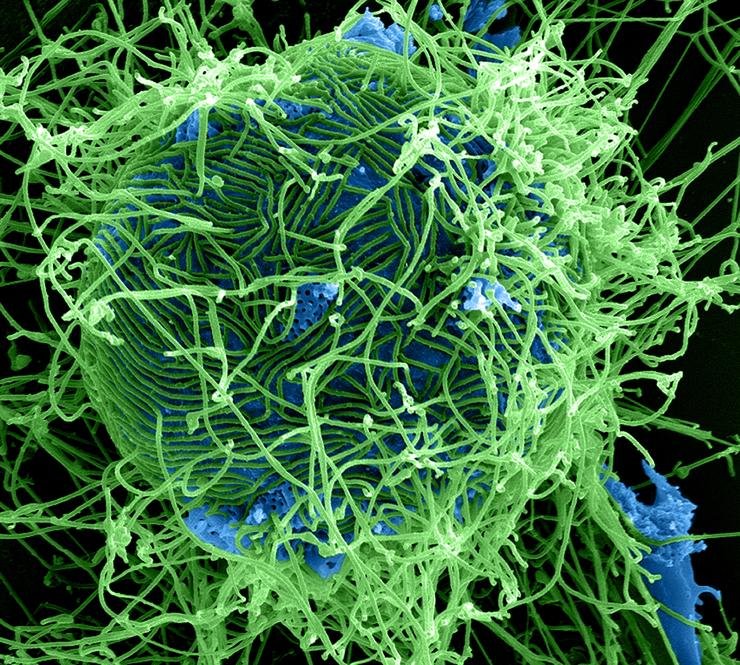
Photo Credit: National Institute of Allergy and Infectious Diseases (NIAID)
In the Democratic Republic of Congo (DR Congo) and Uganda, a new outbreak of Ebola was discovered on May 16. As of Jun. 8, in the DR Congo, there are 598 confirmed cases and 115 confirmed deaths, and in Uganda, there are 19 confirmed cases, two confirmed deaths, one probable case, and one probable death according to the Centers for Disease Control and Prevention (CDC).
It is the third-largest outbreak of Ebola by case count ever, as per The Wall Street Journal, only behind the 2014 Western African epidemic and the 2018 Kivu epidemic.
The Ebola disease is caused by a group of six known species of the viruses known as orthoebolaviruses. The first strain of the virus was discovered in Zaire (what is now known as the DR Congo) in 1976. According to the World Health Organization (WHO), the average case fatality rate (CFR) of Ebola disease is around 50 per cent, but it has ranged from 25–90 per cent in past outbreaks.
This current epidemic is not caused by the Zaire ebolavirus, but instead the Bundibugyo ebolavirus, according to the WHO. Both the 2014 Western Africa epidemic and the 2018 Kivu Epidemic were caused by the Zaire ebolavirus, making this the largest ever outbreak of Bundibugyo ebolavirus in history. This complicates efforts to treat the disease, as most Ebola treatments only work for the Zaire ebolavirus strain.
Currently, there is no approved vaccine for Bundibugyo ebolavirus, unlike Zaire ebolavirus. The Coalition for Epidemic Preparedness Innovations (CEPI) — a non-profit organization that accelerates vaccine development and was founded in 2017 by the governments of India and Norway, the Bill & Melinda Gates Foundation, and the Wellcome Trust — announced on Jun. 1 that it will “urgently accelerate” the development of three potential vaccines for the Bundibugyo virus. The three vaccines are currently being developed by the International AIDS Vaccine Initiative (IAVI), Moderna, and the University of Oxford, and the CEPI has committed $3.2 million, $50 million, and $8.6 million USD to the institutions developing these vaccines, respectively. The vaccines will be manufactured at the Serum Institute of India (SII).
The earliest known suspected case was a 59-year-old man who developed symptoms on Apr. 24 and died three days later, according to AP News. By the time the Africa CDC had become aware of the outbreak on May 5, there were 50 suspected deaths.
However, according to sources close to The Telegraph, local medics informed several non-profit organizations — including the International Rescue Committee (IRC), Action Aid and Doctors Without Borders (MSF) — that the first case of this current epidemic may have potentially been as far back as January.
Local medics theorize that the outbreak could have started with an individual who was treated at a hospital in Rwampara, a town in Ituri Province of the DR Congo, in January. The patient infected eight healthcare workers before dying in February. If confirmed, it would mean that the virus was allowed to spread for nearly five months before being detected.
On May 17, the WHO declared the outbreak a public health emergency of international concern (PHEIC). In that announcement, the WHO reported that as of May 16, there were 246 suspected cases and 80 suspected deaths in Ituri Province of the DR Congo, as well as two cases and one death in Kampala, the capital city of Uganda.
A PHEIC is the highest warning that the WHO can issue. This is the ninth time Ebola has been declared a PHEIC since the designation was created in 2005.
On May 29, the DR Congo Ministry of Health removed suspected cases and deaths that had tested negative, were duplicated, or could not be tested or verified, pending further investigation, according to the CDC. Before this, on May 27, as per the WHO, there were 906 suspected cases and 223 suspected deaths. Afterwards, though, on May 29, the WHO reported a total of 134 confirmed cases in the DR Congo, including nine in Uganda, with 18 deaths among the confirmed cases.
However, in a statement released on Jun. 1, the US-based International Rescue Committee (IRC) warned that the epidemic is “likely significantly larger” than official figures suggest. They added that response efforts are struggling due to delayed detection and low levels of contact tracing. Finally, the IRC said that only about 20 per cent of contacts are currently being traced, suggesting that local health authorities are struggling to identify and isolate new chains of transmission.