
Strong El Niño Predicted to Raise Temperatures and Cause Extreme Weather Across Globe
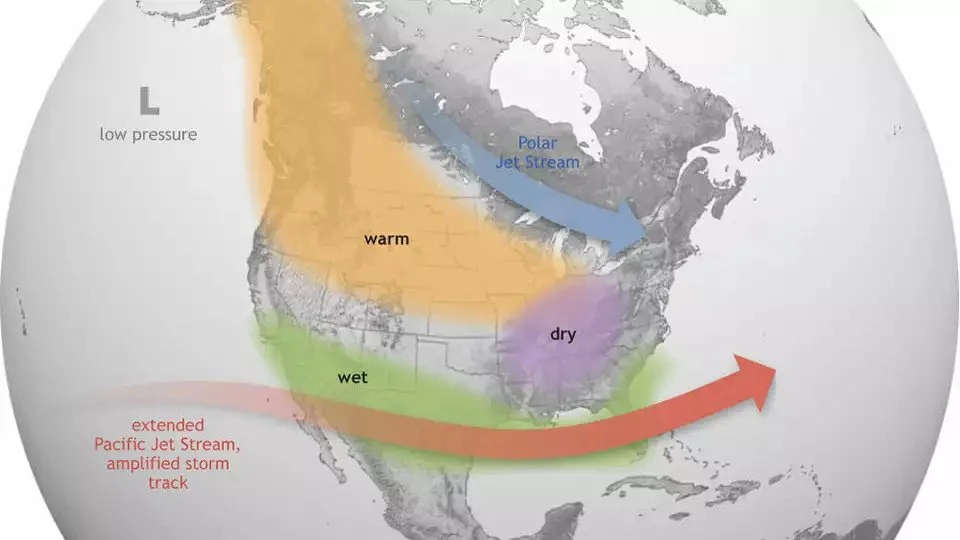
Photo Credit: National Weather Service via American Statesman
A strong El Niño is predicted to emerge this year, which is expected to drive up temperatures around the globe, including in Canada, and increase the risk of extreme weather events. This comes after Environment and Climate Change Canada predicted that 2026 will likely be one of the hottest years on record, as per Global News.
An El Niño appears approximately every two to seven years and lasts about 12 to 18 months. A standard El Niño occurs when ocean temperatures in a particular region of the tropical Pacific are about 0.5°C above the long-term average. A Super El Niño is an exceptionally strong version of an El Niño, and occurs when ocean temperatures rise to about 2°C above the average.
During an El Niño, the Pacific Ocean releases heat into the atmosphere, increasing global temperatures. In contrast, during a La Niña, the ocean is colder and absorbs heat from the atmosphere, leading to cooler global temperatures.
The European Centre for Medium Range Weather Forecasts (ECMWF) found that half of their forecast models pointed towards a temperature increase of over 2.5°C by autumn of 2026, as reported by BBC.
Additionally, the World Meteorological Organization (WMO), a special agency of the United Nations (UN), predicted on Jun. 2 that a moderate or possibly strong El Niño will cause a significant increase in temperatures across the globe, as per CTV News.
According to CTV News, WMO Secretary-General Celeste Saulo also suggested that the upcoming El Niño is a reminder of the need to switch from fossil fuels to renewable energy. “The world must treat [El Niño] as the urgent climate warning it is. [Its] conditions will pour fuel on the fire of a warming world,” said Saulo.
Furthermore, according to a report from the US National Oceanic and Atmospheric Administration (NOAA), an El Niño is 82 per cent likely to emerge in the Northern Hemisphere from May to July 2026. They further stated that an El Niño is likely to continue through the Northern Hemisphere winter from 2026–27, with a 96 per cent chance of continuing from December 2026 to February 2027.
According to Global News, a Super El Niño can make already hot conditions in Canada even hotter, leading to an elevated risk of wildfires and drought. Additionally, warmer winters result in reduced snowfall, causing more precipitation to fall as rain across Canada. As such, this heightened rainfall could lead to higher rates of flooding across the country.
However, according to Vancouver is Awesome, meteorologist Brian Proctor says that Environment Canada’s weather models suggest that Metro Vancouver will have a “very dry and fairly warm summer,” but that their models don’t credit that to the El Niño.
On the other hand, the potential impacts of an El Niño differ greatly around the world. According to Global News, the effects of the El Niño are predicted to be most severe in places such as Peru, Ecuador, East Africa, Central Asia, and southern North America. It is also predicted that it will increase the risk of drought and wildfire in Australia, Indonesia, and parts of South America.