
Photo Credit: CTV News
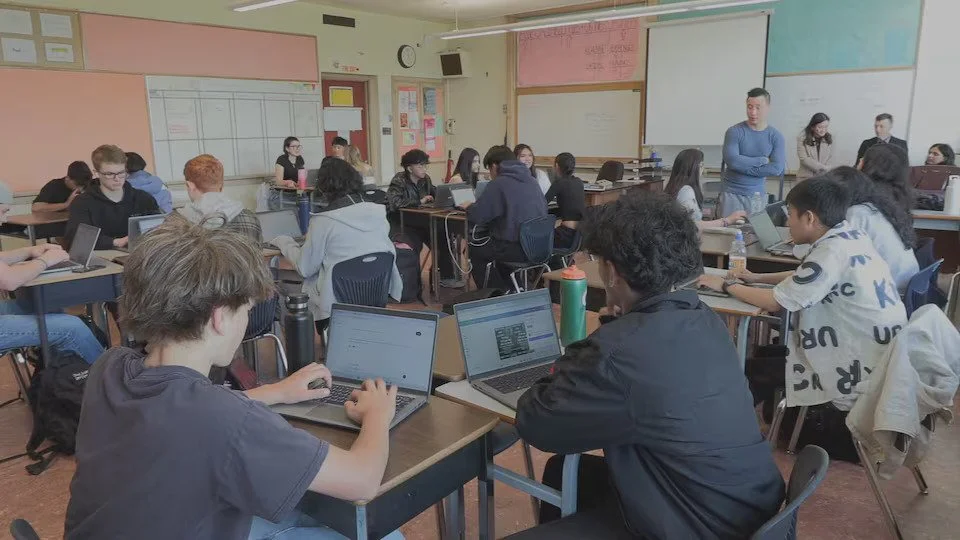
In May 2026, the Vancouver School Board (VSB) announced that it would be providing secondary students aged 13 and older with access to Microsoft Copilot 13+, an artificial intelligence (AI) assistant.
In a statement, the VSB says they are aiming to encourage safe and responsible AI use and prepare students for a world in which technology is highly prevalent.
To understand how this decision has affected students, The Nest spoke to five Hamber students from multiple grades, and asked them about how they use AI.
Many interviewees explained that they do not regularly use Microsoft tools, such as Copilot, for schoolwork. Instead, some students use programs such as ChatGPT to research topics and clarify difficult concepts, while others choose not to use AI at all.
“I use [AI] for drafting and study sheets, mainly,” said Samuel Lazarian (10). However, he does not use Copilot regularly. Instead, he uses other AI tools.
Jackson Newland (10) said that he uses AI approximately once a week, mainly to search for information and explain difficult concepts. He said that he uses AI to understand his work, rather than to complete assignments dishonestly.
“I think we should be able to use it a little bit, but we shouldn’t cheat with it,” he added.
A student in grade 9 also described occasionally using AI for research, particularly when exploring topics in social studies. They said it helps them deepen their knowledge and develop a better understanding of subjects. “It helps me understand and expand on topics, so [I can] get more information on [them].” The Nest is not naming this Hamber student, because they requested to remain anonymous.
Not everyone, however, sees AI as a necessary learning tool.
Mila Chan (8) said she never uses AI for schoolwork because she’s concerned about its environmental impacts.
“Well, first off, AI is really bad for the environment, and the reason [why] a lot of climate change is happening is because [of] AI. So, if I can help the world a little bit, I'll stop using AI.” She’s also frustrated that AI features are becoming increasingly integrated into digital platforms, which she says makes AI increasingly difficult to avoid.
Despite the VSB’s decision to provide eligible students with access to Copilot, several Hamber students interviewed said they rarely or never use Copilot.
“Never. Like, not Word, not PowerPoint. I don't use Copilot,” Lazarian said, when asked about this AI use. Some prefer alternatives, while others avoid AI altogether. “I use ChatGPT to get information online or if I'm having trouble with schoolwork.” Newland said.
Nevertheless, most students interviewed by The Nest said that they support the VSB’s decision. Lazarian believes that introducing AI to students aged 13 and older could help them learn to use the technology for educational purposes. And Newland also supports access to AI.
“That's good, because it lets students have it be a bit more flexible, and if they don't understand, they can just look it up, instead of having to meet with the teacher in real life,” he said.
The grade 9 student who requested anonymity said that regulating AI use may be more effective than banning it, since students are likely to encounter the technology regardless.
Others raised concerns about students’ ability to use AI responsibly. Micah Filate (9), another student interviewed, suggested that older students may be better equipped to recognize plagiarism and understand the importance of completing their own work.
“I think people who are older could probably use it more responsibly [...] They’ll be more careful,” Filate says.
Some students reported that their teachers discourage or prohibit AI use, while others said their teachers have not established specific rules beyond broader school expectations.
Students disagree about how strict these policies should be. Newland believes that AI should be permitted when it supports learning, provided students do not use it to cheat. Chan supports restrictions because she believes assignments should reflect students’ own efforts. Filate commented that, while the technology can provide useful assistance, "plagiarism is a thing,” and AI can raise concerns about inaccurate information and students becoming too dependent on AI-generated answers.