
Canada’s Climate Targets Are Slipping As Carney-Smith MOU Contradicts Past Promises
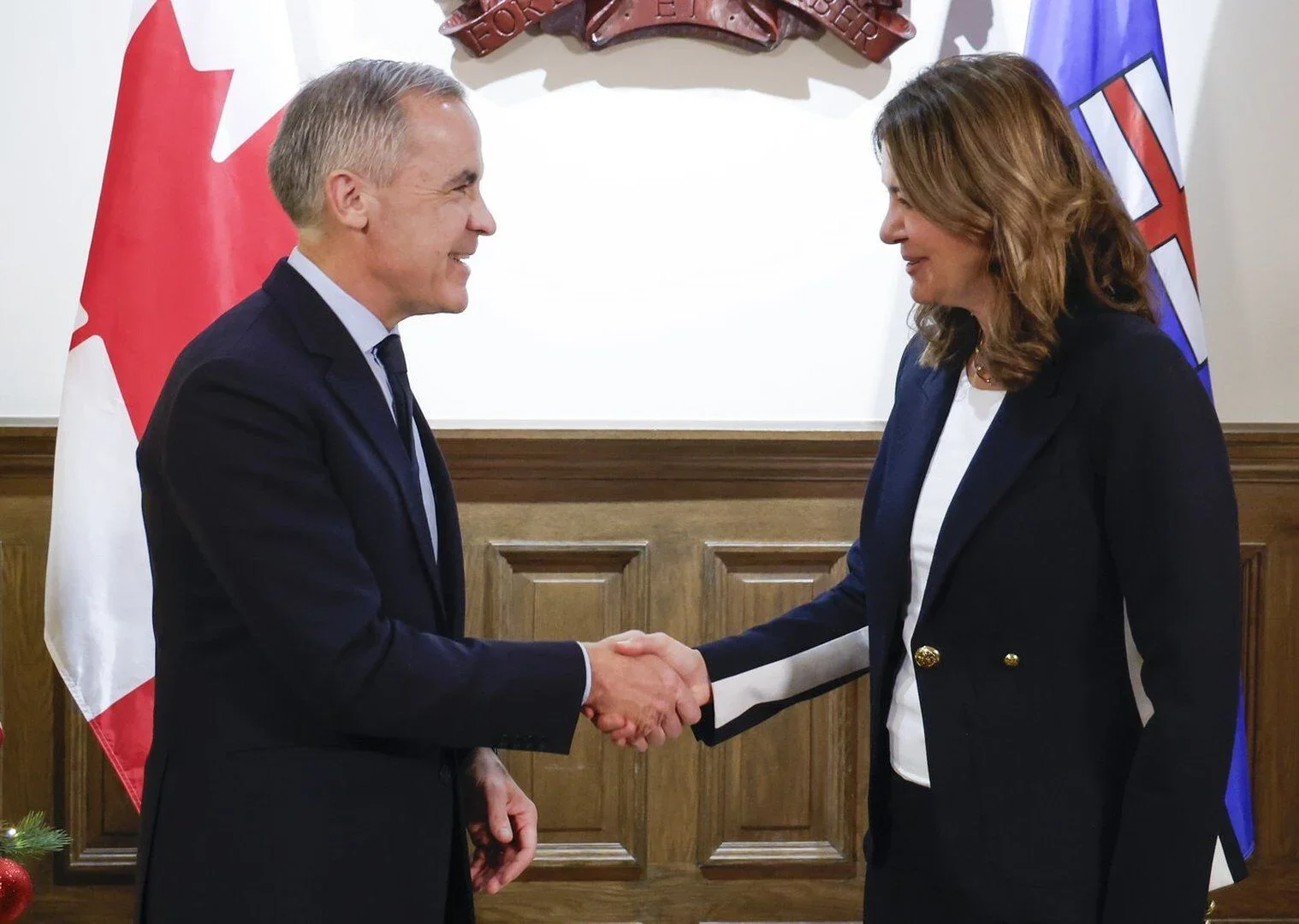
Photo Credit: THE CANADIAN PRESS/Jeff McIntosh via The Toronto Star
Canada’s newest proposal to become “a global energy superpower” disregards the most important thing that superpowers are supposed to do — protect and uphold the futures of their communities.
On Nov. 28, Prime Minister Mark Carney and Alberta Premier Danielle Smith signed a Memorandum of Understanding (MOU) agreeing to disregard federal climate policies to build new energy infrastructure. Through the construction of pipelines, mines, and power plants, the MOU aims to establish Canada as a “global energy superpower.” The act is non-binding, meaning that it outlines promised commitments rather than legally enforceable obligations.
The agreement comes after tension between Canada and Alberta, with a growing Albertan separatist movement and a push for the federal government to ease climate regulations. However, this settlement should not be applauded as a miraculous political feat; rather, it should be criticized as a dangerous precedent for Canada’s future climate plans.
Although Ottawa and Alberta vow to “remain committed to achieving net zero greenhouse gas emissions by 2050,” the MOU’s provisions will make this expectation a mere fantasy.
One of the MOU’s key provisions will happen in our own backyard, as it proposes building a new bitumen pipeline from Alberta to the BC coast.
Examining the 2024 Trans Mountain Pipeline Expansion (TMX) provides a way to reasonably assess the anticipated impacts of this potential future Alberta pipeline, since TMX is also designed to transport a form of bitumen. This comparison casts doubt on the feasibility of Ottawa and Alberta’s climate promises, as the proposed pipeline will generate significant emissions over a prolonged period.
According to an Alberta government official who spoke to POLITICO anonymously, a best-case scenario would see “shovels [...] in the ground somewhere around 2029.” Based on this start date, Maclean’s predicted that an "aspirational" completion date for the project would be 2040.
A 2024 Parliamentary Budget Officer (PBO) report estimated ”cash flows for 40 years after [TMX]’s in-service date.” Extrapolating this to Alberta’s project suggests the pipeline could continue to operate until 2080, likely resulting in enormous, long-term carbon emissions.
The MOU states that the government will “enable the export of bitumen from a strategic deep-water port to Asian markets, including if necessary through an appropriate adjustment to the Oil Tanker Moratorium Act.” Canadian law currently bans most oil tankers from BC’s coastline north of Vancouver Island. Suggesting a need to modify the legislation could imply that the pipeline would go to Prince Rupert or Kitimat, mimicking the route of the previously-proposed Northern Gateway pipeline, which would have also transported bitumen. However, the new proposal calls for a pipeline with a capacity of 300,000 to 400,000 barrels per day, while Northern Gateway was designed to carry 500,000 barrels per day.
A study by Simon Fraser University found that Northern Gateway would “facilitate ‘well-to-wheels’” greenhouse gas emissions of 100 million tonnes per year, and also estimated that the project would operate for 40 years.
The MOU also makes Alberta’s Pathways carbon capture project a “prerequisite to the approval, commencement and continued construction of the bitumen pipeline,” and calls the two projects “mutually dependent.” However, Pathways — the world’s largest carbon capture project — will likely never be able to sequester all the emissions from a new pipeline.
Assuming the new bitumen pipeline operates from 2040 to 2080, and that it facilitates 60 million tonnes of greenhouse gas emissions per year (an extrapolation from the amount predicted for Northern Gateway), the pipeline will still facilitate one gigatonne (or 1,000 million tonnes) of carbon emissions that may not be sequestered by Pathways, according to analysis by The Nest.
As such, the path to reaching net-zero by 2050 becomes more challenging, if not impossible, provided that Canada constructs a new west-coast pipeline.
The MOU also suspended the federal Clean Electricity Regulations (CER) in Alberta, “pending a new carbon pricing agreement [...] administered through Alberta’s own [Technology Innovation and Emissions Reduction] program.” The CER, which came into effect on Jan. 1, aims to reduce emissions from electricity generation in Canada, maintain electricity affordability, and maintain grid reliability.
However, Alberta is now the first province allowed to negotiate its own carbon-pricing agreement, so that it can increase electricity generation ”for consumer and industrial use” and “meet the needs of AI data centres.” After Alberta’s carbon pricing agreement is approved by the federal government, Canada will place the CER in abeyance. However, this deal between Ottawa and Alberta may lead the way for other provinces to also use carbon-pricing negotiations as an excuse to get the CER suspended for themselves.
As the MOU backslides on climate action, it also contradicts Canada’s commitment to reconciliation with Indigenous Peoples. The MOU explicitly declares that “Alberta and Canada recognize their obligations to consult with, and where appropriate accommodate Indigenous peoples [...] in a manner that promotes reconciliation, and respects the rights and cultures of Indigenous Peoples.”
However, some Indigenous groups say this commitment has not been upheld as promised. Trevor Mercredi, the grand chief of Treaty 8 First Nations in Alberta and an Indigenous Advisory Council member for Canada’s Major Projects Office – the same office that projects mentioned in the MOU may be eventually referred to – shared in a press conference that the agreement was “news” to him.
Mercredi learned of the agreement when the public did, despite a request from multiple people at the Indigenous advisory council for the government to liaise with affected First Nations about major project announcements.
The Indigenous advisory council was added to the Major Projects Office after criticism from groups following the implementation of the Building Canada Act. In July, Mercredi voiced to The Canadian Press that he believed Carney had a lot to do to regain the trust of First Nations leaders.
On Dec. 11, Chiefs from Treaty 8 called for a pause on actions stemming from the MOU until Indigenous groups are effectively communicated with and give consent for the projects’ development. Specifically, Mercredi said that Indigenous groups would take “immediate action” if Canada, Alberta, or industry groups decided to move ahead without their input. Some of his proposed actions could create major waves – like Treaty 8 First Nations withdrawing from initiatives, and protecting their sovereign rights through “treaty, constitutional, political and legal mechanisms.”
Similarly, Chief Billy-Joe Tuccaro of Mikisew Cree First Nation outright opposes the MOU, which he explicitly told Carney.
“Carney, Premier Smith, you guys need to get yourselves in order and come and speak to the people that these resources, their lands lie on,” Tuccaro told the CBC.
The Assembly of First Nations has also denounced the MOU, with a unanimous vote that called for Canada and Alberta to withdraw from the agreement, Co-Chair Adam Fiddler announced on Dec. 2
According to Global News, Carney has promised that any pipeline project will include cooperation from Indigenous groups. In January, a joint First Ministers meeting with representatives from First Nations will be held in Saskatoon.
Although Alberta Indigenous Relations Minister Rajan Sawhney promises that “When an application is submitted to the Major Projects Office, the duty to consult will be fully activated,” there has been a historic trend of little consultation and transparency with Indigenous groups. Indigenous right-holders who are in a position to assist the federal government with major projects deserve the dignity of knowing about and consulting on these projects.
Recently, Carney’s first federal budget was approved with crucial votes from opposition MPs, like Green Party leader Elizabeth May. Following the budget’s passing, May said that she voted yes because of commitments Carney made to climate targets, and that she “would have voted no” without that confirmation.
May was quick to condemn her decision after the announcement of the MOU, sharing that it was a “mistake” that she voted for the budget.
“I don’t know if the Prime Minister lied but I think he needs to consider what his word means when his word was given,” she said, according to The Canadian Press.
Along with the switch-up that affected May, Minister of Canadian Identity and Culture and former Minister of Environment Stephen Guilbeault resigned from his Cabinet position following the deal, calling it his “last straw.” Guibeault was one of the cabinet ministers who helped secure May’s vote for the federal budget by relaying confirmation from Carney’s office that tax credits for enhanced oil recovery would not be a part of the budget, but they were later integrated into the MOU.
Guilbeault shared that, as he was no longer the environment minister, he heard details about the MOU through a CBC report. He said that the story enlightened him
“that as part of that agreement we were prepared to sacrifice a certain number of things that I had worked on. I was like, ‘My God, what’s happening?’”
While building bridges with Alberta, Carney continues to burn those with his past allies, leaving behind a trail of broken promises.
The biggest hypocrisy of all can be blamed on both Canada and Alberta, whose promise to hit net-zero carbon emissions looks more and more impractical with each new MOU provision. With the current policy direction of Carney’s Liberals, Canada’s climate promises become all the more unreachable.
While fiscal pressures — including the threat posed by US President Donald Trump’s tariffs — push Canada to make decisions that appear to benefit the economy, we cannot deny the danger that decisions made by our government may pose to the future of our country and its environment.
As students, we are the future of Canada. In elementary school, members of The Editorial Board were among the thousands of students galvanized during Greta Thunberg's Fridays for Future movement in 2019. And yet here we are, still, facing a government that has not considered how its decisions may affect young people and their futures.
We are the citizens who will watch if Canada falls flat on the promise of net-zero by 2050. We will be the leaders scrambling to repair the pieces of a broken environment, struggling to reverse the effects of past projects. We will be the ones losing our homes to forest fires and floods, and watching as oil spills pollute our oceans. As steps are taken to implement the MOU’s provisions, the Editorial Board urges the government to evaluate how these projects will affect Indigenous communities, Canada’s climate commitments, and future generations.